Guides
Complete Guide to Fuse Types (with Diagrams)
Fuses sort by reset behaviour, speed, AC/DC, breaking capacity and form factor. Here's the map of every common family and where you'll meet it.
On this page
The Problem: “Fuse” Is a Whole Family, Not One Part
Ask for “a fuse” and you’ve named a category with dozens of members. A tiny surface-mount chip on a phone board, a color-coded blade in your car, a screw-in plug fuse in an old fuse box, a sand-filled ceramic brick in an industrial panel, and a pole-mounted drop-out fuse on a power line are all fuses — and almost none of them are interchangeable.
That matters because the wrong type fails in ways the right amp rating can’t fix. A glass fuse that physically drops into a slot may have far too little breaking capacity for the fault current there. A fast-acting fuse on a motor blows on every startup. An AC-rated fuse in a DC circuit may not extinguish the arc at all. “It fit” is not the same as “it protects.”
The good news: behind the variety there’s a simple structure. Learn the handful of characteristics that define any fuse, and the families sort themselves by the job they do. This guide gives you the map — first the organizing principles, then the common types grouped by where you’ll actually meet them.
How Fuse Types Are Organized
Every fuse can be placed by five characteristics. Get these, and the specific product names stop being intimidating.
1. Reset behavior — one-time or resettable. The vast majority are sacrificial: an element melts, the fuse is done, you replace it. A smaller group are resettable — PTC (polymeric positive temperature coefficient) devices, also called polyfuses, whose resistance spikes when they heat up under overcurrent and returns to normal once they cool. You’ll find PTCs protecting USB ports, battery packs, and motors, where self-recovery beats swapping a part. A third, older category is the rewireable fuse, where you replace just the fuse wire.
2. Response speed — how fast it blows.
- Fast-acting (F, FF) trips almost instantly — for electronics and steady loads.
- Time-delay / slow-blow (T, TT) rides through brief startup surges — for motors, transformers, and lamps.
- Ultra-rapid semiconductor (aR) is faster still, with very low let-through energy — to protect diodes, thyristors, and IGBTs.
- Industrial fuses use letter codes for the same idea: gG/gL (general purpose), aM (motor-rated), aR/gR (semiconductor).
3. AC or DC. DC has no zero-crossing to help quench the arc, so DC fuses are built with more aggressive arc suppression and carry lower voltage ratings than the same body does on AC. The two are generally not interchangeable — see our how to read a fuse guide for decoding AC/DC voltage markings.
4. Breaking (interrupting) capacity — LBC vs HBC/HRC. This is the maximum fault current a fuse can safely clear. A low-breaking-capacity fuse (a glass 3AG or 5×20mm) is fine on a small appliance but would rupture on a big fault. A high-rupturing-capacity (HRC) fuse uses a ceramic body packed with quartz sand to absorb enormous fault energy — which is why panels and motor circuits use them and radios don’t.
5. Form factor — the body shape. The shape usually tells you the family before you read a marking: flat blade, cylindrical cartridge (glass or ceramic), bolt-down tag/stud, screw-in plug/bottle, or tiny SMD/chip.
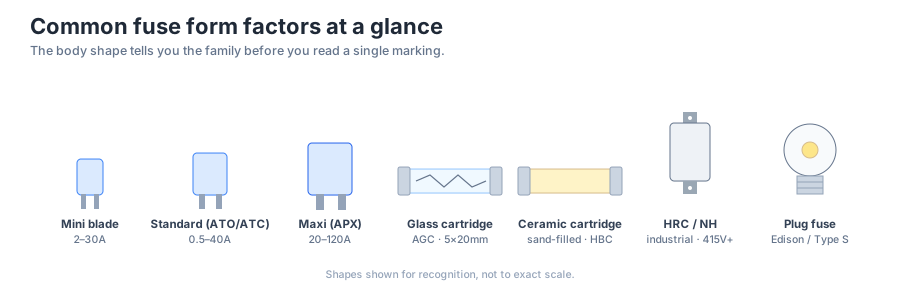 The body shape usually identifies the family at a glance (shown for recognition, not to exact scale).
The Common Fuse Types, by Where You Use Them
Here’s the map. Each family below is defined by the job it does, not just its shape.
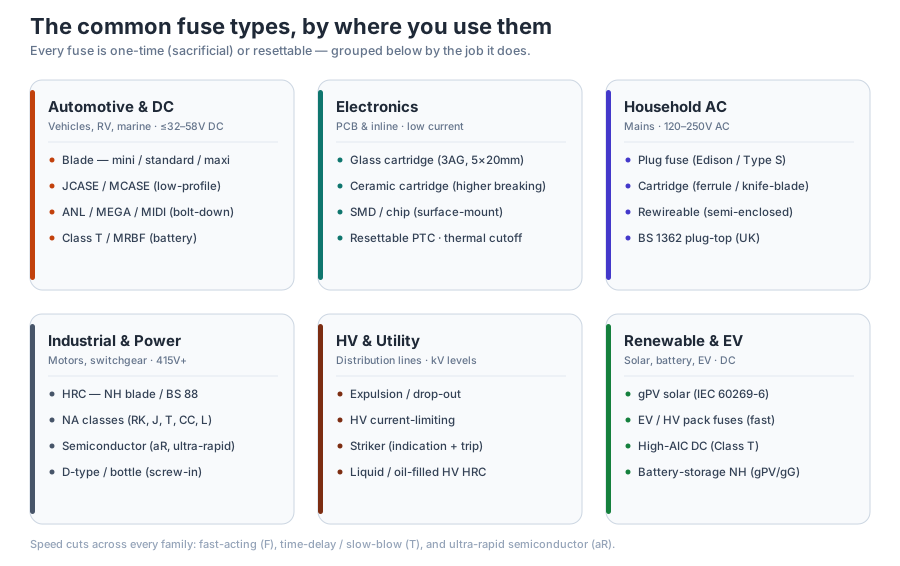
The common fuse families, grouped by the job each one does.
Automotive & DC (vehicles, RV, marine — usually ≤32–58V DC). The workhorses are blade fuses, color-coded and made in escalating sizes: Micro2/Micro3, Low-Profile Mini (APS/ATT), Mini (ATM/APM), Standard/Regular (ATO/ATC), and Maxi (APX). Above those sit cartridge-style JCASE/MCASE fuses for higher-current OEM circuits in tight boxes, and bolt-down high-current fuses — ANL, MEGA (AMG), MIDI (AMI) — for main feeds, inverters, winches, and big audio. Battery banks use Class T and terminal MRBF fuses for their high interrupting capacity. Older vehicles used glass (AGC) fuses and fusible links. (For sizing a specific blade rating, see the 30-amp fuse guide.)
Electronics (PCB and inline, low current). Small glass cartridge fuses — 3AG (¼”×1¼”) and 5×20mm (M205) — are everywhere in appliances and power supplies; the glass lets you see the element. Ceramic cartridge fuses share those footprints but add sand filling for higher breaking capacity. On circuit boards you’ll find SMD/chip fuses and radial/axial subminiature fuses, plus resettable PTC devices (yellow-orange discs or green SMD chips). Thermal fuses — one-shot cutoffs that open at a set temperature rather than a current — protect hairdryers, coffee makers, and transformer windings.
Household AC (mains, 120–250V). Older homes use screw-in plug fuses on an Edison base; Type S (Fustat) versions add a rejection base so nobody can install an oversized fuse. Larger residential and commercial circuits use cartridge fuses — ferrule type up to about 60A and knife-blade type above that — for ranges, subpanels, and main disconnects. The old rewireable (semi-enclosed) fuse, a porcelain carrier with replaceable wire, is cheap and reusable but imprecise and largely obsolete. In the UK and Ireland, a BS 1362 ceramic fuse (3A or 13A) sits inside the appliance plug itself.
Industrial & power (motors, switchgear — 415V and up). This is HRC (High Rupturing Capacity) territory: ceramic, sand-filled, built to interrupt very high fault currents. Common formats are DIN NH (rectangular ceramic with knife-blade terminals), British Standard BS 88 (cylindrical with bolt tags), and North American cartridge classes (H, K, RK1/RK5, J, T, CC, G, L). Semiconductor fuses (aR) protect power electronics in drives, UPS, and rectifiers. D-type (Diazed) and DO (Neozed) bottle fuses are screw-in general-purpose protection common in Europe, and a switch-fuse / fuse-switch combines isolation with protection (compared in our isolator vs fuse switch disconnector guide).
HV & utility (distribution lines, kV levels). Expulsion and drop-out fuses use gas-producing materials (like boric acid) to blow out the arc; the drop-out design also swings open to give a visible break and isolation. HV current-limiting and liquid/oil-filled fuses protect transformers and feeders on the grid. Striker fuses add a spring-loaded pin that signals a blown fuse and can trip associated switchgear.
Renewable & EV (solar, battery, EV — DC). Solar arrays use gPV fuses built to IEC 60269-6 (and UL 2579 in North America) to protect PV strings, including reverse-current faults. Battery-storage systems lean on NH/HRC and high-AIC DC fuses, and EV drivetrains use fast, high-voltage DC fuses sized for the battery pack. (Voltage-class choices are covered in the solar PV fuse guide.)
Quick comparison
| Family | Typical types | Ratings (rough) | The job it does |
|---|---|---|---|
| Automotive & DC | Blade, JCASE, ANL/MEGA, Class T | 1–500A, ≤58V DC | Protect individual vehicle/boat circuits and battery feeds |
| Electronics | Glass/ceramic cartridge, SMD, PTC, thermal | mA–15A, low V | Protect boards, appliances, and small devices |
| Household AC | Plug (Edison/Type S), cartridge, rewireable | 3–100A, 120–250V | Protect home wiring, outlets, and appliance circuits |
| Industrial & power | HRC (NH, BS 88), semiconductor, D-type | 2–1250A, 415V+ | Protect cables, motors, and switchgear at high fault currents |
| HV & utility | Expulsion, drop-out, current-limiting | up to kA at kV | Protect transformers and distribution lines |
| Renewable & EV | gPV, EV, battery NH | to 1500V DC | Protect PV strings, storage banks, and EV packs |
Once you know the family, the last step is matching the electrical spec to your circuit:
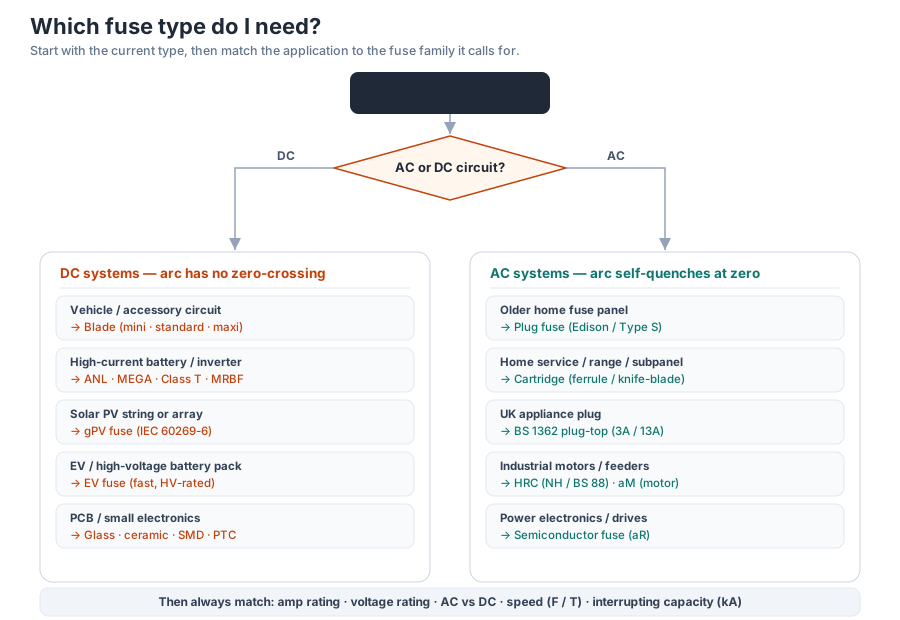 Start with AC or DC, match the application to a family, then confirm the electrical ratings.
Tool Solution: Identifying and Choosing the Right Type
Picking the right type is part identification, part matching it to the job. A few things make both reliable.
Identify what you’re holding. Body shape narrows the family fast (use the form-factor diagram above). For an unmarked fuse, digital calipers plus the printed rating let you look up the exact part on a manufacturer datasheet. Our guide on how to read a fuse covers decoding the amp, voltage, and speed markings.
Match the type to the job — the right kit, not just the right amps.
- Vehicle, boat, RV accessory circuits: a color-coded blade fuse assortment (and the correct blade size for your box).
- Appliance / electronics repair: a glass and ceramic cartridge assortment in 3AG and 5×20mm, in both fast and time-delay.
- Home fuse panel: the correct plug or cartridge fuse — and Type S adapters to prevent future over-fusing.
- Big battery/inverter/solar: Class T, MRBF, or gPV fuses with adequate DC voltage and interrupting ratings — not automotive blades.
- Industrial panel or motor: the specified HRC (NH / BS 88 / NA class) with the right speed code (gG, aM, or aR).
Confirm the four ratings before you buy. Whatever the type, match amp rating, voltage rating, AC/DC, and breaking capacity to the circuit. Get the amp rating right with our fuse sizing guide, the AC/DC question with the how to read a fuse guide, and — for the industrial choice between general-purpose and ultra-fast protection — the HRC vs semiconductor fuse comparison. If you’re weighing a resettable device instead, see fuse vs circuit breaker.
Key Takeaways
- “Fuse” is a family, not a part. Dozens of types exist, and most are not interchangeable — fitting a holder isn’t the same as protecting the circuit.
- Every fuse sorts by five traits: reset behavior, speed, AC/DC, breaking capacity, and form factor.
- Reset behavior: almost all are one-time; PTC/polyfuses reset themselves after cooling.
- Speed: fast-acting (F) for electronics, time-delay (T) for motors and inrush, ultra-rapid (aR) for semiconductors.
- Breaking capacity is why the type matters: glass cartridge for small loads, ceramic HRC (NH, BS 88) for high fault currents in panels and motors.
- Group by use: automotive/DC (blade, JCASE, ANL, Class T), electronics (glass/ceramic, SMD, PTC, thermal), household AC (plug, cartridge, rewireable), industrial/power (HRC, semiconductor), HV/utility (expulsion, drop-out), renewable/EV (gPV, battery).
- DC needs DC-rated types with adequate interrupting capacity — gPV for solar, Class T/MRBF for battery banks.
- Choosing comes down to four ratings: amp rating, voltage, AC/DC, and breaking capacity — matched to your specific circuit.
This guide is for general educational purposes. For panel, high-voltage, solar, or battery work — and anything you’re unsure about — consult a qualified electrician or engineer and follow the equipment manufacturer’s specifications and local electrical codes.
Frequently asked questions
What are the main types of fuses?
Grouped by use: automotive/DC (blade, JCASE, ANL/MEGA, Class T), electronics (glass and ceramic cartridge, SMD, PTC, thermal), household AC (plug/Edison, cartridge, rewireable), industrial/power (HRC — NH and BS 88 — and semiconductor), HV/utility (expulsion, drop-out), and renewable/EV (gPV, battery). Almost all are one-time; PTCs are resettable.
What's the difference between a fast-acting and a slow-blow fuse?
Speed. Fast-acting (marked F) trips almost instantly and suits electronics and steady loads. Slow-blow / time-delay (marked T) tolerates the brief inrush current of motors, transformers, and lamps, so it doesn't nuisance-blow at startup while still opening on a real fault.
Can I replace one fuse type with another?
Only if the substitute truly matches — same amp and voltage rating, correct AC/DC, adequate breaking capacity, right speed, and a proper physical fit. A fuse that merely fits the holder can still be the wrong choice electrically, giving inadequate protection or constant nuisance blowing.
What is an HRC fuse?
A High Rupturing (or Breaking) Capacity fuse: a ceramic body filled with quartz sand that absorbs the energy of very high fault currents without rupturing. Common forms are DIN NH blade fuses and BS 88 cartridges, used in industrial panels, motor circuits, and power distribution.
What is a resettable fuse (PTC)?
A polymeric PTC (polyfuse) sharply increases its resistance when overcurrent heats it, cutting the current; once it cools it returns to normal — no replacement needed. They're common in USB ports, battery packs, and small motors.
What's the difference between a glass and a ceramic cartridge fuse?
Same footprint, different capability. Glass lets you see the element and is fine for low fault currents; ceramic is sand-filled for much higher breaking capacity and higher-temperature environments. Don't assume they're interchangeable just because they're the same size.
Which fuse type should I use for solar or a battery bank?
DC-rated fuses built for the job: gPV fuses (IEC 60269-6) for PV strings, and Class T, MRBF, or NH fuses with high interrupting capacity for battery banks. Never use AC-only or low-AIC automotive fuses on high-energy DC.
What fuse types are in a typical car?
Mostly blade fuses in several sizes (mini, standard, maxi), often with JCASE cartridges and bolt-down ANL/MEGA fuses for high-current circuits; some older vehicles also use glass fuses and fusible links.
Request a quote
Know the circuit but not the part?
Tell us the voltage, current and what you're protecting — our applications team will spec it and quote within one business day.