Guides
30 Amp Fuse Guide: Types, Uses & How to Pick
30 amp is a rating, not a shape — the same 30A rating comes as blade, JCASE, glass-tube, plug and stud-mount fuses. Here's how to identify the right type, verify the spec, and avoid the two mistakes that create hazards.
On this page
Most people assume a “30 amp fuse” is a single, universal part. It isn’t. A 30A rating tells you the current at which the fuse element melts and opens the circuit — but that same rating ships in half a dozen physically different bodies, across two very different worlds: low-voltage DC systems (cars, trucks, RVs, boats, solar) and household AC systems.
The Problem: Why “30 Amp” Isn’t One Fuse
That mismatch creates two ways to get it wrong, and both are expensive:
- Wrong rating. Fitting a 30A fuse where the circuit and wiring were designed for less is the single most dangerous mistake in electrical work. The fuse is sized to protect the wire, not the device — so an oversized fuse lets the wire overheat before the fuse ever blows. In household wiring, a normal branch circuit is only rated for 15 or 20 amps, and dropping a 30A fuse in one is a genuine fire hazard. A 30A fuse belongs on a circuit actually built for 30A — a dryer, a subpanel, a dedicated accessory feed.
- Wrong type. Even with the correct rating, the wrong body won’t seat in your holder, or it’ll be the wrong response speed and blow every time your motor starts. A glass-tube 30A won’t fit a blade slot; a fast-acting 30A will nuisance-trip on a compressor’s inrush current that a time-delay 30A would ride out.
The fix is a two-step process. First, identify the right fuse type (the physical fuse and its response). Then verify the spec (rating, voltage, wire gauge, environment) so you don’t create a hazard. Work through both before you buy.
How to Identify the Right 30A Fuse Type
Your goal here is to name the exact fuse family you need before you shop, so you buy something that physically fits and behaves correctly.
Step 1 — Find the fuse you’re replacing (and read the diagram). Locate the blown or existing fuse. In vehicles you usually have two boxes — one under the dash, one under the hood — so check both. Open the cover and read the printed diagram or your owner’s manual: it tells you the slot’s amperage and, often, the fuse type. Pull the old fuse (a fuse puller helps) and keep it in front of you as your reference.
Step 2 — Identify the physical form factor. Match the old fuse’s body to one of these 30A-capable families:
| Type | Looks like | Where it’s used |
|---|---|---|
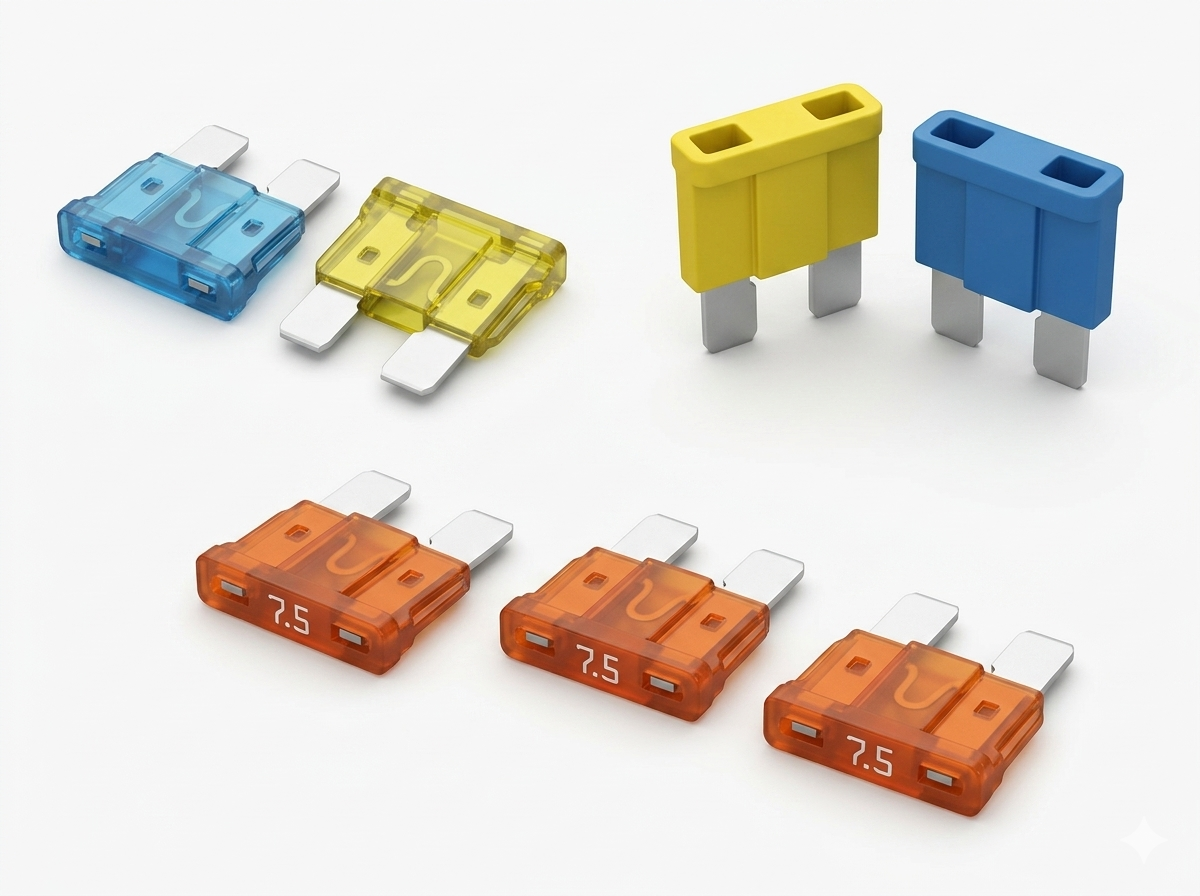
| Standard blade (ATC/ATO) | Rectangular, two flat prongs, ~19 mm wide | The default in most modern cars, trucks, boats, RVs |
| Mini blade (ATM) | Same shape, smaller | Newer/compact vehicles, tight fuse boxes |
| Maxi blade (APX) | Larger blade, heavier prongs | High-current feeds, motors, main circuits |
| Low-profile / JCASE | Cartridge-style, sits low in the box | Modern vehicle power-distribution boxes, engine bays |
| Glass tube (AGC/SFE) | Cylindrical glass with metal end caps | Older vehicles, marine, specialty equipment |
| Edison-base plug fuse | Round, screws in like a bulb | Older residential fuse panels (dryer/subpanel loads) |
| Stud-mount (AMI/MEGA) | Metal tabs that bolt down | High-power distribution, aftermarket, large vehicles |
Step 3 — Match it to your application.
- Car/truck audio, lighting, accessories → standard ATC/ATO blade, or mini/JCASE in newer vehicles.
- RV / trailer / brake controller → standard blade at the power center; check the panel diagram for the correct slot.
- Boat / marine / anything exposed → look for corrosion-resistant, marine-rated, and ideally a waterproof holder; glass-tube AGC is common on older builds.
- Home fuse panel → Edison-base plug fuse, and only on a circuit genuinely rated for 30A.
Step 4 — Use color as a cross-check (not the source of truth). On blade fuses, 30A is green. That’s a fast visual confirmation — but never rely on color alone across form factors, because there’s no reliable link between a fuse’s physical size and its amp rating (a violet mini blade is 3A, while a violet maxi is 100A). Always read the number printed on top.
The result: a specific name, e.g., “30A green standard ATC/ATO blade” or “30A low-profile JCASE” or “30A Edison-base time-delay plug fuse.”
How to Pick the Right 30A Fuse (Spec Checklist)
Now confirm the fuse you’ve named is actually safe and correct for the circuit. Run every step — skipping one is how people create hazards.
Step 1 — Match the amperage exactly. Never oversize. Replace a 30A fuse with a 30A fuse. Do not “upgrade” to 40A to stop nuisance blows — a fuse that keeps blowing is telling you something is wrong (an overload or a short), and a bigger fuse just removes the protection while the wiring keeps overheating. If you want to go smaller for extra caution, that’s safe but you’ll trip more often.
Step 2 — Check the voltage rating. Confirm the fuse’s voltage is rated at or above your circuit’s:
- Automotive / marine / RV DC: typically 12V–32V DC.
- Residential AC: typically 125V or 250V.
A fuse rated for a lower voltage than your circuit can fail to interrupt an arc safely. Higher-rated is fine; lower is not.
Step 3 — Choose fast-acting vs. time-delay (slow-blow). This is the setting most people miss.
- Fast-acting reacts almost instantly to overcurrent — ideal for electronics and circuits that don’t surge on startup.
- Time-delay / slow-blow tolerates a brief inrush without blowing — essential for motors, compressors, pumps, and incandescent/tungsten loads that spike hard for the first fraction of a second. A 300W fan motor might draw ~25A running but 35–38A in the first moment of startup; a slow-blow rides that out where a fast-acting would nuisance-trip.
Step 4 — Confirm the wire gauge supports 30A. In home and custom wiring, the wire — not your preference — sets the fuse size. As a rule of thumb, ~10 AWG copper is the wiring associated with a 30A circuit (for comparison, 14 AWG → 15A, 12 AWG → 20A). If any part of the run is thinner than what 30A demands, that thin section is your weak point and a 30A fuse won’t protect it. When in doubt on household circuits, have a licensed electrician confirm.
Step 5 — Match certifications and environment.
- Look for UL-listed (or equivalent) fuses for reliability and code compliance.
- For engine bays, boats, trailers, and outdoor installs, choose rugged, vibration- and heat-tolerant construction, and waterproof holders for anything exposed to weather or spray.
The result: a fully specified part, e.g., “30A, 32V DC, time-delay JCASE, UL-listed” or “30A, 125V, time-delay Edison-base plug fuse.”
Recommended 30 Amp Fuses & Holders
Once you know your type and spec, match it to a part from our range — or send us the old fuse and we’ll confirm the Tenso equivalent.
For most cars, trucks, boats & RVs — standard blade (ATC/ATO) Our automotive blade fuses cover Micro, Mini, Low-Profile Mini, Standard ATO/ATC and Maxi formats from 1 to 100 A at 32 V or 58 V, colour-coded to ISO 8820. For a 30A circuit, look for the green standard ATC/ATO in your fuse box diagram.
For fuse boxes and distribution If you’re building or replacing a vehicle fuse panel, our automotive fuse boxes and 12V/24V holders are designed to work with the blade range — one supplier, matched parts.
For marine, trailer & outdoor use — waterproof inline holder Pair a 30A blade with an inline fuse holder rated for your wire gauge and environment. For exposed installs, specify sealed or IP-rated options when you request a quote.
For older builds — glass tube (AGC/SFE) Our glass tube fuses cover 5×20 and 6×30 formats in fast- and time-lag speeds — common on older marine and equipment circuits where a cylindrical fuse is still specified.
Don’t forget the tool that makes it painless A fuse puller and continuity tester (often bundled in blade-fuse kits) saves you from prying fuses out by hand. If you’re not sure whether a fuse is blown, see our guide on how to test a fuse with a multimeter.
Key Takeaways
- “30 amp” is a rating, not a shape. The same 30A rating comes as standard/mini/maxi blade, JCASE, glass-tube, Edison-base plug, and stud-mount fuses — pick the body that fits your holder.
- Match three things to the old fuse: exact 30A rating, form factor/socket, and voltage (12–32V DC for vehicles/marine; 125/250V for household AC).
- Never oversize a fuse. The fuse protects the wire, so a bigger fuse just lets the wiring overheat. A 30A fuse belongs only on a circuit designed for 30A.
- On blade fuses, 30A is green — but always read the printed number, since size and rating aren’t reliably linked.
- Choose response speed by load: time-delay (slow-blow) for motors and surging loads; fast-acting for electronics and short-circuit protection.
- Wire gauge sets the limit: ~10 AWG for a 30A circuit; a thinner section is a weak point a 30A fuse won’t protect.
- A repeatedly blowing fuse signals a fault (overload, short, or wrong type) — diagnose it, don’t upsize it.
This guide is for general educational purposes. For household electrical work or any installation you’re unsure about, consult a licensed electrician and follow your equipment manufacturer’s instructions and local electrical codes.
Frequently asked questions
Can I put a 30 amp fuse in place of a 20 amp?
No. The fuse protects the wiring, and a standard branch circuit built for 20A uses wire that can overheat before a 30A fuse blows — a real fire risk. Replace a fuse only with the same rating the circuit was designed for.
What color is a 30 amp fuse?
On standard, mini, and maxi blade fuses, 30A is green. Treat color as a quick confirmation only, and always read the amperage printed on the fuse — physical size and rating aren't reliably linked across fuse types.
What wire gauge do I need for a 30 amp circuit?
Roughly 10 AWG copper is associated with a 30A circuit (14 AWG → 15A, 12 AWG → 20A). If any part of the run is thinner, that section is unprotected by a 30A fuse. Confirm with a licensed electrician for home wiring.
Is a 30 amp fuse okay for a normal house outlet circuit?
No. Standard residential outlet and lighting circuits are 15A or 20A. A 30A fuse belongs only on a circuit specifically built for it — such as a dryer, water heater, or a subpanel/special load.
Should I use a fast-acting or slow-blow 30A fuse?
Use time-delay (slow-blow) for anything with a startup surge — motors, compressors, pumps, and incandescent loads — so it doesn't nuisance-trip. Use fast-acting for electronics and circuits that don't spike on startup and need immediate short-circuit protection.
Why does my 30 amp fuse keep blowing?
A repeatedly blowing fuse is a symptom, not the problem. It usually means an overload (too much on the circuit), a short circuit, or the wrong response type (a fast-acting fuse on a motor that surges at startup). Diagnose the cause — never fix it by fitting a larger fuse.
Can I use a circuit breaker instead of a 30A fuse?
Often yes. A correctly rated 30A resettable inline circuit breaker provides equivalent overcurrent protection and resets with a button instead of needing a spare — popular for marine, RV, and trolling-motor DC systems. Match the amperage, voltage, and environment rating just as you would a fuse.
Keep reading
Related articles
Request a quote
Know the circuit but not the part?
Tell us the voltage, current and what you're protecting — our applications team will spec it and quote within one business day.