Guides
How to Read a Fuse: Amp Rating, Voltage & Color Codes
A fuse encodes at least four specs beyond the amp number. Here's how to decode the markings and use colour codes as a cross-check.
On this page
The Problem: A Fuse Says More Than One Number
Most people read the amp number on a fuse and stop there. But a single fuse encodes at least four separate specifications, and matching only the amperage while ignoring the rest is how you end up with a fuse that fits but doesn’t protect, won’t physically fit at all, or nuisance-blows every time a motor starts.
The information is all there — it’s just easy to miss. Ratings are often tiny and embossed rather than printed, sometimes worn smooth with age, and frequently written in codes: a “T” or “F” for speed, an “RMS” AC voltage that peaks higher than it reads, a “50kA” interrupting rating that has nothing to do with the amp rating, an “L” or “H” for breaking capacity. On top of that, the color that lets you identify a blade fuse at a glance can mean completely different things on different fuse bodies.
Reading a fuse correctly comes down to two skills. First, decode the markings so you know all four specs, not just one. Second, use color as a fast cross-check while understanding where the color code stops being reliable. The next two sections cover each.
How to Decode the Markings on a Fuse
Work through these in order. For a replacement, the first three (amps, voltage, speed) plus physical fit are what you must match.
1. Amp rating — the current threshold. This is the number followed by “A” (amperes) — or “mA” for very small fuses. On blade fuses it’s embossed on the top face; on glass and ceramic cartridge fuses it’s usually on a metal end cap. Occasionally it’s baked into the part number (e.g., a Bussmann FNQ-5 is a 5A fuse). This is the continuous current the fuse carries before its element melts. Match it exactly on a replacement — never go higher. One caveat when reading it: amp ratings are set at about 25°C (77°F). In a hot engine bay or enclosure, a fuse effectively carries less and can blow below its marked number; in the cold it tolerates a bit more.
2. Voltage rating — the maximum it can safely interrupt. Shown in volts, often with AC or DC specified: “250VAC,” “32VDC,” or a dual rating like “600VAC/450VDC.” Some fuses use a small AC or DC symbol next to the number instead of letters. Two rules: the fuse’s voltage rating must be equal to or greater than your circuit’s, and the AC/DC type must match — an AC-only fuse doesn’t belong in a DC circuit, and vice versa, unless the fuse is explicitly dual-rated. (For why AC and DC ratings differ so much, see our companion guide on AC vs DC fuses.) Note that a higher voltage rating is safe; a lower one is dangerous, because it may let the arc jump the gap during a fault.
3. Speed code — how fast it blows. Small fuses mark the element speed with letters: F (fast-acting), M (medium), T (time-delay / slow-blow), plus FF (very fast) and TT (very slow). Larger industrial fuses use codes like gG / gL (general purpose) and aM (motor-rated). Some simply say “fast acting,” “slow blow,” or “motor rated.” Match the speed to the load: slow-blow for anything with a startup surge (motors, compressors, lamps), fast-acting for sensitive electronics. If there’s no speed marking at all, you’ll need the manufacturer’s part number and datasheet to know.
| Marking | Meaning | Typical use |
|---|---|---|
| FF | Very fast-acting | Highly sensitive semiconductors |
| F | Fast-acting | General electronics, short-circuit protection |
| M | Medium | Mixed loads |
| T | Time-delay (slow-blow) | Motors, transformers, inrush loads |
| TT | Very slow / long time-delay | High, sustained inrush |
| gG / gL | General-purpose (industrial) | Cables and general circuits |
| aM | Motor-rated (industrial) | Motor branch circuits |
4. Interrupting (breaking) rating — don’t confuse it with amps. The interrupting rating (I.R., or breaking/rupture capacity) is the maximum fault current the fuse can safely clear without rupturing — for example “50kA,” or an L (low) or H (high) letter on small cartridge fuses. It is always much higher than the amp rating and describes a different thing entirely: not when the fuse blows, but whether it can safely break a large short-circuit. It matters most when finding an equivalent fuse across brands.
5. Agency marks — proof it was tested. Look for UL (Underwriters Laboratories), CSA (Canada), or CE marks. These indicate the fuse was tested to perform to its ratings. An uncertified fuse may not blow as its numbers claim.
6. Body type and size — what determines fit. Note the body material (glass, ceramic, plastic) and the form factor: the blade family (standard ATO/ATC ≈ 0.5–40A, mini ATM 2–30A, micro/low-profile, maxi APX 20–120A, JCASE), or a cartridge/bottle fuse. For cylindrical fuses, the dimensions are the identity — measure overall length and cap diameter (common electronics fuses are 5×20 mm or ¼”×1¼”). Precise size matters: mini and micro fuses protect similar circuits but are not interchangeable, and a loose fit causes arcing and heat.
7. If the markings are worn off. Don’t guess. Check the fuse-box diagram or legend on the cover, the owner’s/equipment manual, or measure the fuse’s dimensions and look up the part number on the manufacturer’s datasheet. For a blade fuse, the housing color will also narrow it down — which brings us to the next section.
How to Use Fuse Color Codes as a Cross-Check
Color is a genuinely useful shortcut — but only for blade fuses, and only within limits.
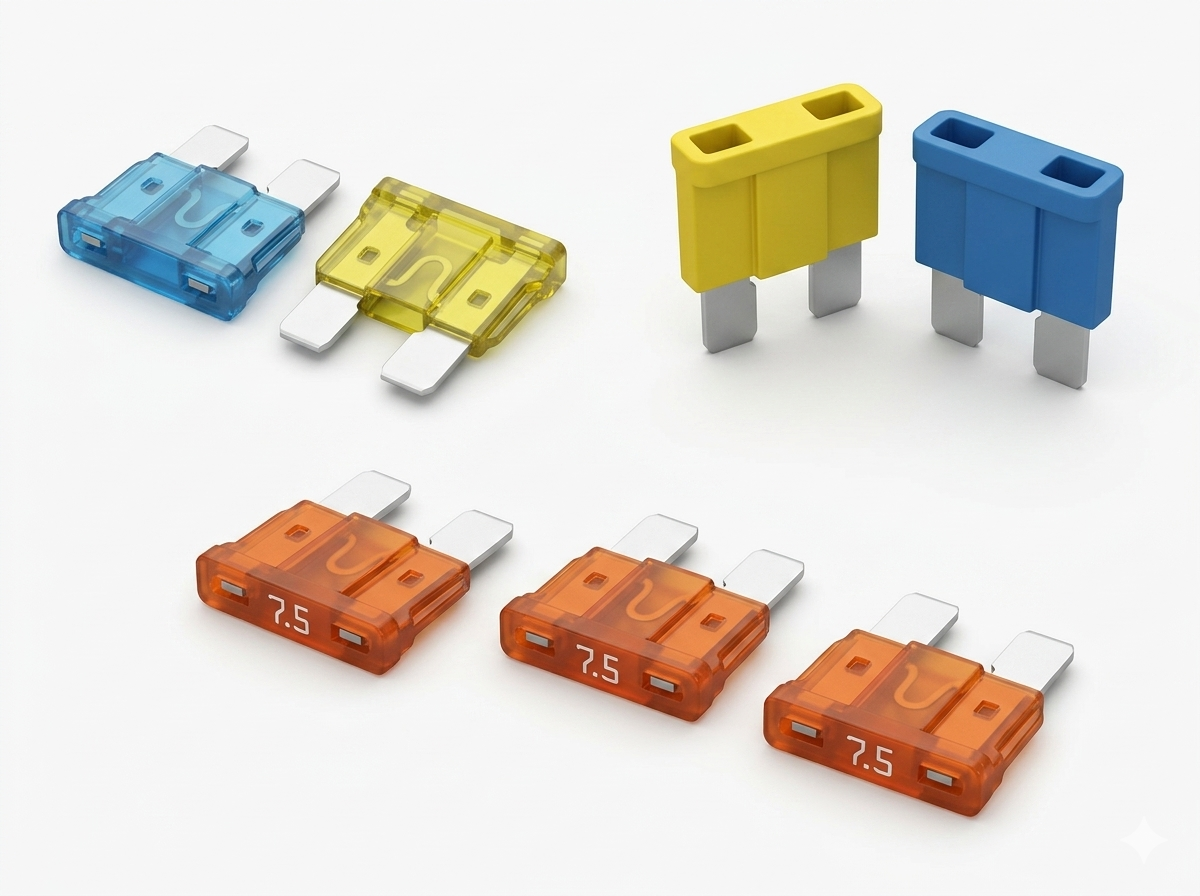
1. What the color is for. Blade fuses share identical shapes across many amp ratings, so the plastic housing is color-coded to let you spot the right rating (or a blown one) instantly in a packed fuse box or poor light — without reading the fine print. Most automotive blade fuses follow the DIN 72581 color standard.
2. The standard blade color chart (standard ATO/ATC and mini).
| Amp rating | Color |
|---|---|
| 1A | Black |
| 2A | Grey |
| 3A | Violet |
| 4A | Pink |
| 5A | Tan (beige) |
| 7.5A | Brown |
| 10A | Red |
| 15A | Blue |
| 20A | Yellow |
| 25A | Clear / natural |
| 30A | Green |
| 35A | Blue-green |
| 40A | Orange |
(Standard fuses span roughly 0.5–40A; mini fuses use the same colors but only from about 2–30A.)
3. Where the color code stops being reliable — read this before you trust it.
- Color is standardized only within a fuse family. Maxi (APX) and other high-current fuses use a different, overlapping scale, so the same color can mean a wildly different amperage across sizes. The classic example: a violet fuse is 3A as a standard/mini blade, but a violet maxi can be 100A. Never read color across fuse sizes without checking the number.
- Glass and cartridge fuses have no color code at all — you must read their printed markings.
- Old, aftermarket, or faded fuses may not match. Some older European vehicles (Bosch, Lucas) used entirely different color schemes, and a sun-faded 25A “clear” fuse can look like something else.
4. The rule: color narrows it down; the number and size confirm it. Use color to find candidates fast, then verify against the amperage stamped on the fuse and its physical size. A color-only swap is exactly how the wrong-rated fuse ends up in a circuit — and an over-rated fuse defeats the protection entirely. (For choosing and sizing a specific rating, see our 30-amp fuse guide.)
Tool Solution: Tools That Make Reading a Fuse Easy
Reading a fuse also means confirming whether it’s good or blown. A few inexpensive tools make both painless.
A multimeter (continuity setting) — the essential one. Set to continuity and touch a probe to each end: a good fuse beeps/reads near zero ohms, a blown one reads open. This is critical for glass and ceramic fuses, where the break can hide — the solder at a cap can melt before the visible element, so a fuse that looks intact is actually dead (high-amp glass fuses are notorious for this). You can even probe a blade fuse’s exposed top tabs without pulling it.
A fuse puller. Pulls blade or cartridge fuses out cleanly so you can read and measure them without bending prongs or cracking glass.
A test light or circuit tester. A fast live/dead check at the fuse without a full meter — handy in a vehicle fuse box.
Magnification and good light. Fuse markings are small and often embossed rather than inked. A magnifier or your phone’s flashlight held at an angle makes embossed ratings readable.
A blade-fuse color/amp reference card — and the manual. Keep a printed DIN color chart in the glovebox or toolbox, and hang on to the fuse-box legend and owner’s manual — they tell you the intended rating for each slot when a fuse is worn or missing.
Digital calipers. For an unmarked cartridge or blade fuse, measuring the dimensions lets you match it to a datasheet and find the correct equivalent.
Easier-to-read fuses themselves. Color-coded, clearly stamped assortment kits — and “blown-fuse indicator” fuses that light up when they fail — make identification faster, especially in vehicles with 50-plus fuses. When markings are truly gone, the manufacturer’s datasheet (looked up by part number or dimensions) is the final source of truth.
Key Takeaways
- A fuse encodes four specs, not one: amp rating, voltage rating, blow speed, and body type/size. Read all four before replacing one.
- Amp rating is the number + “A” on the top (blade) or end cap (glass); match it exactly and never go higher. It’s rated at ~25°C, so heat makes a fuse blow sooner.
- Voltage rating is the max voltage the fuse can safely interrupt; a higher rating is fine, a lower one is dangerous, and AC/DC must match unless dual-rated.
- Speed codes: F = fast-acting (electronics), T = time-delay/slow-blow (motors and inrush); also M, FF/TT, and industrial gG/aM.
- Don’t confuse amp rating with interrupting rating — the latter (e.g., 50kA, or L/H) is the maximum fault current the fuse can safely clear.
- Standard/mini blade color code (DIN 72581): red 10A, blue 15A, yellow 20A, green 30A, and so on — but this scale holds only within a family.
- Color has limits: maxi and other fuses use a different overlapping scale (violet = 3A standard vs 100A maxi), and glass/cartridge fuses have no color at all. Always confirm the number and size.
- Use a multimeter to confirm a blown fuse — glass fuses in particular can look intact while the element is broken inside the cap.
This guide is for general educational purposes. When in doubt about a fuse’s rating or a repeated failure, consult a qualified electrician or technician and follow the equipment manufacturer’s specifications and local electrical codes.
Frequently asked questions
Where is the amp rating printed on a fuse?
On blade fuses, it's embossed on the top face. On glass or ceramic cartridge fuses, it's usually stamped on a metal end cap. Sometimes it's built into the part number (for example, an FNQ-5 is a 5A fuse). It's the number followed by "A" (or "mA" for very small fuses).
What do "T" and "F" mean on a fuse?
They indicate blow speed. **T** = time-delay (slow-blow), which tolerates brief startup surges — good for motors and transformers. **F** = fast-acting, which trips almost instantly — good for sensitive electronics. You may also see **M** (medium), **FF**/**TT** (very fast / very slow), or industrial codes like **gG** and **aM**.
What color is a 15, 20, or 30 amp fuse?
On standard and mini blade fuses: 15A is **blue**, 20A is **yellow**, and 30A is **green**. Treat this as a quick check only — always confirm with the number stamped on the fuse, because maxi and other high-current fuses use a different color scale where the same color can mean a very different amperage.
Do glass or cartridge fuses have color codes?
No. Only blade-style fuses are color-coded. For glass and ceramic fuses you must read the printed markings, and because the internal break can be hidden, it's best to confirm whether one is blown with a multimeter rather than by eye.
What does the voltage number mean, and can I use a higher-voltage fuse?
The voltage rating is the maximum voltage the fuse can safely interrupt without the arc jumping the gap during a fault. Using a fuse with a **higher** voltage rating is safe as long as the amperage is identical; using a **lower** one is dangerous. The AC/DC type must also match unless the fuse is dual-rated.
What's the difference between the amp rating and the interrupting rating?
The **amp rating** is the continuous current at which the fuse blows (e.g., 5A). The **interrupting (breaking) rating** is the maximum fault current it can safely clear without rupturing (e.g., 50kA, or an L/H marking). They're different specs — the interrupting rating is always far higher — so don't confuse the two.
How do I read a fuse if the markings are worn off?
Don't guess a rating. Check the fuse-box diagram or legend on the cover, consult the owner's or equipment manual for that slot, or measure the fuse's dimensions and look up the part number on the manufacturer's datasheet. For a blade fuse, the housing color will also help narrow it down.
Why do two different fuses have the same color?
Because the color-to-amperage scale is standardized only within a fuse family. Maxi (APX) fuses overlap the standard/mini colors on a different scale, so a color can repeat at a different rating — a violet standard fuse is 3A, but a violet maxi can be 100A. Always verify the printed number *and* the physical size.
Request a quote
Know the circuit but not the part?
Tell us the voltage, current and what you're protecting — our applications team will spec it and quote within one business day.