Comparisons
HRC Fuse vs Semiconductor Fuse Explained
Both are ceramic HRC bodies, but gG and aR fuses do opposite jobs — cable protection vs semiconductor protection — and aren't interchangeable.
On this page
The Problem: Same Body, Opposite Jobs
Put a general-purpose HRC fuse next to a semiconductor fuse and they look like cousins — both are ceramic bricks or cylinders, packed with quartz sand, bolted in or mounted in an NH holder. And technically they are related: a semiconductor fuse is a specialized subclass of the HRC family. That resemblance is exactly why they get confused and, worse, substituted for one another.
They’re built for opposite priorities. A general-purpose HRC fuse guards the cable and the general circuit, tripping on anything from a slow overload up to a massive short. A semiconductor fuse guards the silicon device — and only against the catastrophic short — but it does so fast enough to save a junction that would otherwise vaporize in microseconds.
Swap them and you lose one way or the other. Fit an ordinary HRC fuse in a variable-frequency drive and it clears too slowly: the IGBT is destroyed before the fuse even melts. Fit a semiconductor (aR) fuse on a distribution feeder and the cable has no overload protection at all — the fuse only reacts to a dead short. The distinction that keeps you safe is encoded in the fuse’s two-letter class marking, and — as with any fuse — matching the amp rating alone is not enough.
How HRC and Semiconductor Fuses Actually Differ
They share a family — and a construction. Both are HRC (High Rupturing Capacity) fuses: a silver element in a strong ceramic body filled with high-purity quartz sand that absorbs the arc’s energy. A semiconductor fuse simply takes that platform and optimizes it — specially shaped, multi-notched elements designed for the fastest possible melting and the lowest let-through energy. So the honest comparison isn’t “HRC vs semiconductor” so much as general-purpose HRC (gG/aM) vs semiconductor HRC (aR/gR/gS).
The two-letter code tells you everything. Every IEC 60269 fuse carries a utilization category. The first letter (lowercase) is the breaking range:
- g (from German gesamt, “full”) — full-range: interrupts everything from the smallest melting overload up to the maximum short circuit. It protects against both overload and short circuit.
- a (from ausschließlich, “partial/accompanied”) — partial-range: interrupts only fault currents above a set threshold (a short circuit). It provides no overload protection and must be paired with something that does.
The second letter (uppercase) is what it protects:
- G — general cables and line-side equipment (older L meant cables, now superseded by G).
- M — motor circuits.
- R — semiconductors (rectifiers, thyristors, power transistors).
Put together:
| Class | Range | Protects | Notes |
|---|---|---|---|
| gG (old gL) | Full | Cables / general circuits | The most common industrial fuse |
| aM | Partial | Motor circuits | Withstands inrush; needs an overload relay for overload |
| aR | Partial | Semiconductors | Ultra-fast, short-circuit only, lowest I²t |
| gR | Full | Semiconductors | Overload + short-circuit; slightly slower on shorts than aR |
| gS | Full | Semiconductors + cables | Full-range for both the device and the wiring |
Speed and let-through energy (I²t) — the heart of it. Power semiconductors can be destroyed in microseconds, faster than an ordinary fuse can react. Semiconductor fuses clear in the µs–ms range with a precisely controlled, very low I²t (the “Joule integral,” or let-through energy — the energy that passes through while the fuse clears). The rule is simple: the fuse’s I²t must be lower than the semiconductor’s withstand I²t, or the device fails first. General-purpose HRC fuses operate at the millisecond level — fast and current-limiting on a short, but with far more let-through than a semiconductor fuse. The trade-off for that blistering speed is higher watt loss in the semiconductor fuse during normal operation.
Breaking capacity. Both are high; semiconductor fuses are often rated above 100 kA, general-purpose HRC typically 10–100 kA.
Standards. General-purpose HRC fuses fall under IEC 60269-1/-2 (and UL 248 / CSA C22.2). Semiconductor fuses have their own standard, IEC 60269-4 (Semiconductor Protection), plus UL 248-14.
Side-by-side comparison
| Factor | General-purpose HRC (gG) | Semiconductor fuse (aR / gR / gS) |
|---|---|---|
| Protects | Cables and general circuits | Power semiconductors (IGBT, thyristor, diode) |
| Protection range | Full (overload + short) | aR/gR/gS varies; aR is short-circuit only |
| Speed | Milliseconds | Microseconds — much faster |
| Let-through (I²t) | Higher | Very low (must beat device withstand) |
| Watt loss (normal) | Lower | Higher |
| Breaking capacity | ~10–100 kA | Often >100 kA |
| Standard | IEC 60269-1/-2 | IEC 60269-4 |
| Typical use | Distribution boards, cables, feeders | Drives, UPS, rectifiers, inverters |
How to Choose Between Them
Choosing is mostly a matter of naming what you’re protecting, then matching the numbers.
Step 1 — What are you actually protecting?
- Cables / general distribution → gG, sized to the cable’s ampacity.
- A motor branch → aM for short-circuit protection plus an overload relay (aM alone won’t protect against overload), or a gG fuse where full-range protection is preferred.
- A power-electronic device (IGBT, thyristor, diode in a drive, UPS, or rectifier) → a semiconductor fuse: aR for short-circuit protection alongside separate overload protection, or gR/gS for full-range semiconductor protection.
Step 2 — For semiconductors, match the energy, not just the amps. The critical numbers come from the semiconductor’s datasheet. The fuse’s I²t and peak let-through current must sit below the device’s withstand values, and its voltage and interrupting ratings must exceed the circuit’s. A fuse with the right amp rating but too much let-through will let the junction fail. This is why semiconductor-fuse selection is really a coordination exercise with the device.
Step 3 — Confirm voltage and AC/DC. Drives, PV inverters, and battery systems are frequently DC, so you’ll often need a DC-rated semiconductor fuse. (See our AC vs DC fuses guide for why DC ratings differ.)
Step 4 — Respect the partial-range caveat. An a-class fuse (aM, aR) only interrupts high fault currents — it needs a companion device to handle overloads. And aR must not be used to replace gR: the aR has no overload protection, so it isn’t a drop-in for a full-range part.
Quick scenarios.
- 50 kW, 400 V distribution feeder → gG.
- 22 kW motor, direct-on-line start → aM + overload relay.
- Variable-frequency drive, UPS, or rectifier with IGBTs → aR (with the drive’s own overload protection) or gR/gS.
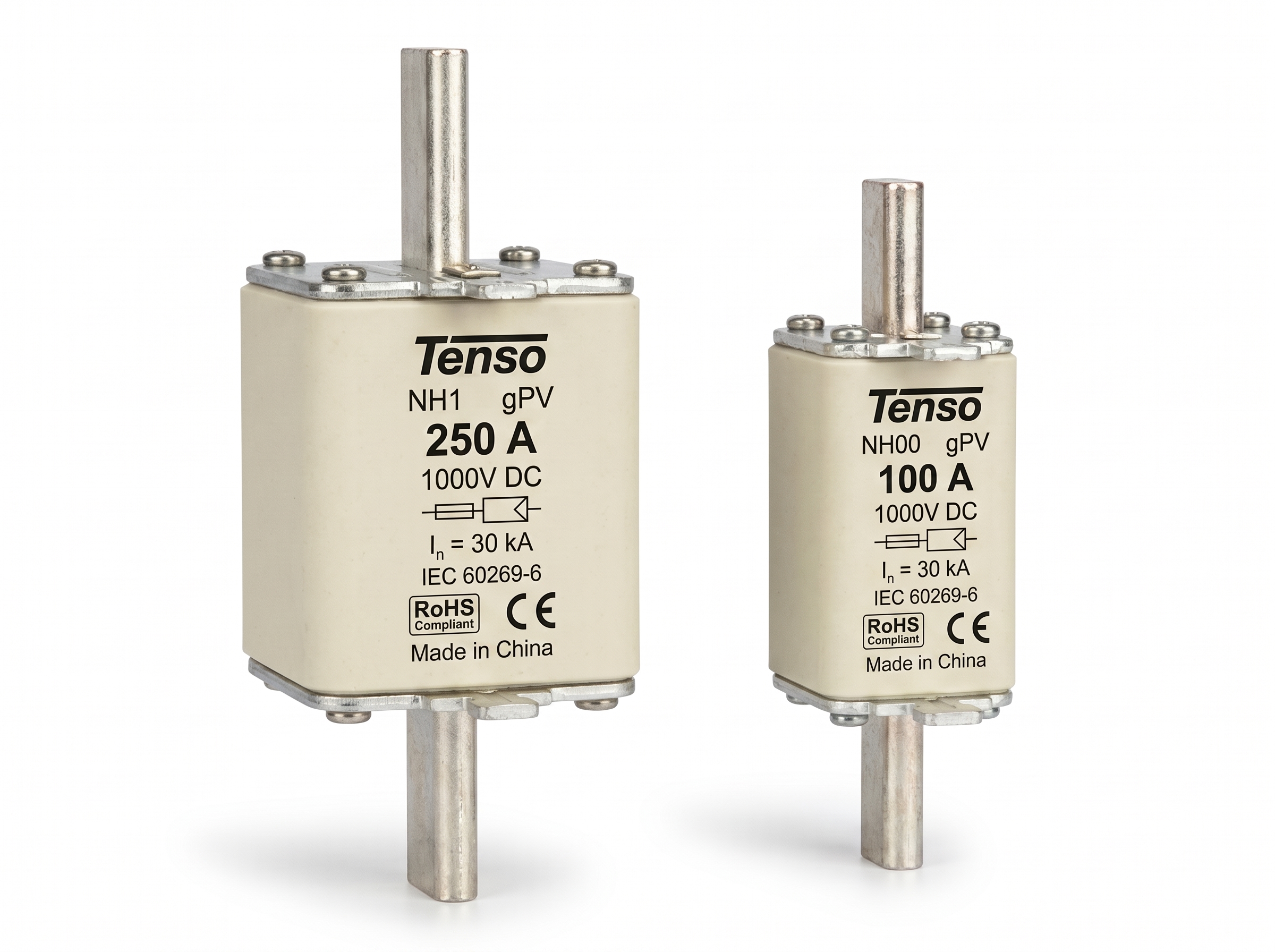
- Solar PV string or battery bank → dedicated gPV or battery-class DC fuse (see the solar PV fuse guide).
The bottom line on swapping: a gG fuse can’t save a semiconductor (too slow, too much let-through), and an aR fuse won’t protect a cable against overload (it only catches dead shorts). They are not substitutes.
Tool Solution: Specifying the Right Fuse
Read the class marking first. The two-letter category is printed on the fuse — check it before anything else. gG for cables, aM for motors, aR/gR/gS for semiconductors. (Our complete guide to fuse types maps where each family fits.)
Follow the equipment manufacturer’s specified fuse. For a drive, UPS, or rectifier, the maker publishes the exact semiconductor fuse — often a specific part number — that coordinates with the device’s I²t withstand. Use it. Substituting a “close enough” fuse can void the warranty and leave the semiconductor unprotected.
Pick the right format and ratings. Semiconductor fuses come in square-body, cylindrical, NH (DIN), and BS 88 styles. Whatever the format, match the voltage rating, AC/DC, breaking capacity (Icn), and — for semiconductors — the I²t and peak let-through against the device withstand. Size general-purpose gG fuses to the cable with our fuse sizing guide.
Know when a fuse is the right protector at all. Semiconductor fuses exist because breakers are too slow to save silicon — a good example of where a fuse beats a breaker (see fuse vs circuit breaker). For general circuits, either can work; for power electronics, the fuse’s speed is essential.
Key Takeaways
- A semiconductor fuse is a specialized HRC fuse — same construction, optimized for ultra-fast semiconductor protection.
- The two-letter class is the decoder: first letter = range (g full/overload+short, a partial/short-only); second = object (G cables, M motors, R semiconductors).
- gG protects cables and general circuits across the full overload-to-short range, at millisecond speed.
- Semiconductor fuses (aR/gR/gS) protect silicon — IGBTs, thyristors, diodes — in microseconds, with very low let-through energy (I²t).
- They do opposite jobs and aren’t interchangeable: a gG is too slow to save a semiconductor; an aR gives a cable no overload protection.
- Match energy, not just amps: a semiconductor fuse’s I²t and peak let-through must beat the device’s withstand values (from the datasheet).
- Mind the range letter: an “a” fuse needs companion overload protection, and aR is not a substitute for gR.
- Follow the equipment maker’s specified fuse for drives, UPS, and rectifiers, and use DC-rated parts where the circuit is DC.
This guide is for general educational purposes. Industrial and power-electronic protection should be specified by a qualified engineer in accordance with the equipment manufacturer’s coordination data and the applicable IEC/UL standards.
Frequently asked questions
Is a semiconductor fuse an HRC fuse?
Yes. It's a specialized, ultra-fast subclass of the HRC family — same ceramic, sand-filled, high-breaking-capacity construction, but with an element optimized for microsecond clearing and very low let-through energy to protect semiconductors.
What do "gG" and "aR" mean?
They're IEC utilization categories. The first letter is the protection range — **g** = full-range (overload *and* short circuit), **a** = partial-range (short circuit only). The second is the object protected — **G** = general cables, **M** = motors, **R** = semiconductors. So gG protects cables fully, and aR protects semiconductors against short circuits only.
Can I use a general HRC (gG) fuse to protect a drive or IGBT?
No. A gG fuse clears in milliseconds and lets through too much energy; a semiconductor destroyed in microseconds would fail long before the fuse melts. Power electronics need a semiconductor fuse (aR/gR/gS).
Can I use a semiconductor (aR) fuse in a general distribution circuit?
No. An aR fuse is partial-range — it only interrupts high short-circuit currents and provides no overload protection, so a cable on that circuit would be unprotected against sustained overloads.
What's the difference between aR, gR, and gS?
**aR** is partial-range (short-circuit only), the fastest with the lowest I²t. **gR** is full-range (overload and short-circuit) for semiconductors. **gS** is full-range for both the semiconductor and the cable. Note that aR is *not* a valid replacement for gR because it lacks overload protection.
What is I²t, and why do semiconductor fuses obsess over it?
I²t (the Joule integral) is the let-through energy that passes while a fuse clears. Semiconductors fail on energy, fast, so the fuse's I²t must be lower than the device's withstand I²t — the whole point of a semiconductor fuse is minimizing that number.
Are semiconductor fuses more expensive or run hotter?
Generally yes on both counts — they're specialized, and their fast-melting element design produces higher watt loss during normal operation. You use them only where semiconductors actually need protecting.
How do I know which fuse a specific drive needs?
The drive or UPS manufacturer specifies it — usually an exact semiconductor fuse coordinated with the device's I²t withstand. Follow that recommendation rather than choosing by amp rating alone.
Request a quote
Know the circuit but not the part?
Tell us the voltage, current and what you're protecting — our applications team will spec it and quote within one business day.