Guides
Choosing a Solar PV Fuse: 1000V vs 1500V DC
A solar string fuse must be gPV-rated and matched to the array's maximum cold-corrected voltage and string current — ordinary DC fuses won't do.
On this page
The Problem: Two Decisions, One Special Fuse
Protecting a PV string comes down to two decisions that are easy to conflate and easy to get wrong — plus one rule that overrides both.
The first decision is the voltage class: 600V, 1000V, or 1500V DC. The trap is that a fuse must be rated for the array’s maximum DC voltage, which isn’t the nominal figure — it’s the string’s open-circuit voltage after correcting for the coldest temperature the site sees, because Voc rises as it gets colder. Fit a 1000V fuse on an array whose cold-corrected voltage reaches into 1500V territory and the fuse may fail to interrupt a fault.
The second decision is the current rating, and here PV breaks the usual habit. You don’t “size to the load,” because a PV module is a current-limited source: a fault produces only slightly more current than normal operation, so an ordinary fuse can’t draw enough current to blow quickly. The real threat isn’t forward overload at all — it’s reverse current, where a shorted string gets backfed by the healthy strings paralleled with it.
Those two characteristics — DC arcing with no natural zero-crossing, and low-multiple reverse-current faults — are why you can’t use a standard DC or automotive fuse here. Only a gPV fuse (designed and tested to IEC 60269-6 or UL 2579) can clear these faults safely; a non-gPV fuse may sustain an arc or even explode, and using one violates NEC Article 690.9. This guide covers both decisions — the voltage class and the sizing — with the gPV requirement running through both.
Choosing the Voltage Class: 1000V vs 1500V DC
The three classes, and what 1500V buys. PV fuses come in three DC voltage classes matched to system architectures:
- 600V DC — residential systems (maximum voltage typically ~300–450V).
- 1000V DC — commercial systems (typically ~600–850V).
- 1500V DC — utility-scale (typically ~1200–1400V).
The move to 1500V at utility scale is about economics: a higher ceiling lets you put more modules in series (longer strings), which means lower current for the same power, fewer strings and combiners, and less balance-of-system cost. As modules and inverters support it, 1500V is spreading into large commercial projects too.
The rule: match the fuse to the maximum, cold-corrected voltage. The fuse’s DC voltage rating must be equal to or greater than the array’s maximum open-circuit voltage — and that maximum occurs on the coldest day, not at nominal conditions. Per NEC 690.7, you calculate Voc,cold:
Voc,cold = Voc(STC) × (cold-temperature correction factor) × (modules in series)
using the module’s negative temperature coefficient of Voc for your site’s lowest expected temperature. Then choose a fuse voltage class at or above that figure — IEC 60269-6 recommends a margin of about 1.2× the maximum Voc (roughly 25% headroom). The most common — and dangerous — mistake is assuming the nominal system voltage is the maximum, or ignoring the cold-Voc rise, and ending up with an under-rated fuse. A 1000V-rated fuse does not belong on a 1500V system.
Why it must be a gPV fuse, not just a DC fuse. Three PV-specific challenges make an ordinary fuse unsafe here, and define what a gPV fuse is built to handle:
- DC arc. With no natural current zero-crossing, a DC arc is hard to extinguish — gPV fuses use a long arc-quenching chamber (a 600V AC fuse might only manage 300–400V on DC). (See our AC vs DC fuses guide.)
- Current-limited source. Because a PV fault current is only slightly above operating current, gPV fuses are designed to clear at low overcurrent multiples — roughly 1.35–1.45× their rating within one to two hours.
- Reverse current. gPV fuses are tested to interrupt the reverse fault current that healthy strings push back into a faulted one — the core of the UL 2579 test regime.
gPV fuses are certified to IEC 60269-6 (“supplementary requirements for fuse-links for the protection of solar photovoltaic energy systems”) and, in North America, UL 2579 / UL 248-19, passing extensive tests for reverse current, high temperature (roughly −40°C to +85°C ambient), humidity, vibration, and UV. Standard DC or automotive fuses lack this testing and construction — never substitute them.
Sizing and Placing the String Fuse
Step 1 — Decide whether you even need a string fuse. It depends on how many strings are paralleled, because the hazard is reverse backfeed:
- One or two strings in parallel: usually no fuse required (per NEC 690.9(A)), since the maximum reverse current a faulted string can receive can’t exceed the conductor’s ampacity or the module’s rating.
- Three or more strings in parallel: string fuses are generally required, because the combined backfeed from the other strings can exceed a module’s limit.
The precise test is whether the reverse current — about (N−1) × Isc from the other strings — could exceed the module’s maximum series fuse rating on its datasheet. Many installers add fusing even on smaller arrays anyway, for safe string isolation during service, easier troubleshooting, and future expansion.
Step 2 — Size the fuse (the NEC 156% rule). In North America, the minimum string-fuse rating is 1.56 × Isc, then rounded up to the next standard size. That 1.56 comes from two consecutive 125% factors:
- × 1.25 for maximum current (NEC 690.8(A)(1)) — cold, bright, cloud-edge conditions let a module briefly exceed its rated Isc.
- × 1.25 for continuous duty (NEC 690.9(B)) — a PV array runs 3+ hours, so it’s treated as a continuous load.
(Under IEC, IEC 62548 allows a more flexible 1.5 to 2.4 × Isc to optimize for local conditions.) Standard PV fuse ratings run 10, 12, 15, 16, 20, 25, 30A and up; as higher-power modules push string currents higher, typical ratings are shifting from 15A toward 20–25A.
Step 3 — Apply the two ceilings. The calculated fuse must satisfy both:
- ≤ the module’s maximum series fuse rating (the max OCPD on the datasheet) — protecting the module.
- ≤ the conductor’s ampacity — protecting the wire. If the fuse would exceed the wire rating, upsize the wire (see our fuse sizing guide).
Worked example. A module with Isc = 10.5A: 10.5 × 1.56 = 16.4A → next standard size 20A (or 25A if a higher multiple applies). Confirm 20A is at or below the module’s max series fuse rating and at or below the string wire’s ampacity — if the wire is 10 AWG (~40A), it passes comfortably.
Step 4 — Derate for combiner-box heat. gPV fuses are typically rated at 40°C ambient, but a combiner box in direct sun can hit 65–75°C internally. Above the rated ambient, current capacity drops — apply the manufacturer’s derating curve, and mount fuses vertically (connections down) for convection cooling and water drainage; horizontal mounting traps heat and may cost 10–15% capacity.
Step 5 — Place and fuse correctly. String fuses live in the combiner box / array junction box, one per string. In modern ungrounded (transformerless) systems, both the positive and negative conductors need overcurrent protection, so fuse both poles. Because PV modules stay energized in daylight even when the inverter is off, provide a readily accessible disconnect (NEC 690.15) — a DC load-break or fused disconnect — so fuses can be serviced safely without working live (see isolator vs fuse switch disconnector).
Note that the battery or inverter side of a system uses different, higher-current DC fuses (Class T, or NH gBat to IEC 60269-7), not gPV string fuses — a separate selection.
Tool Solution: Specifying a gPV Fuse
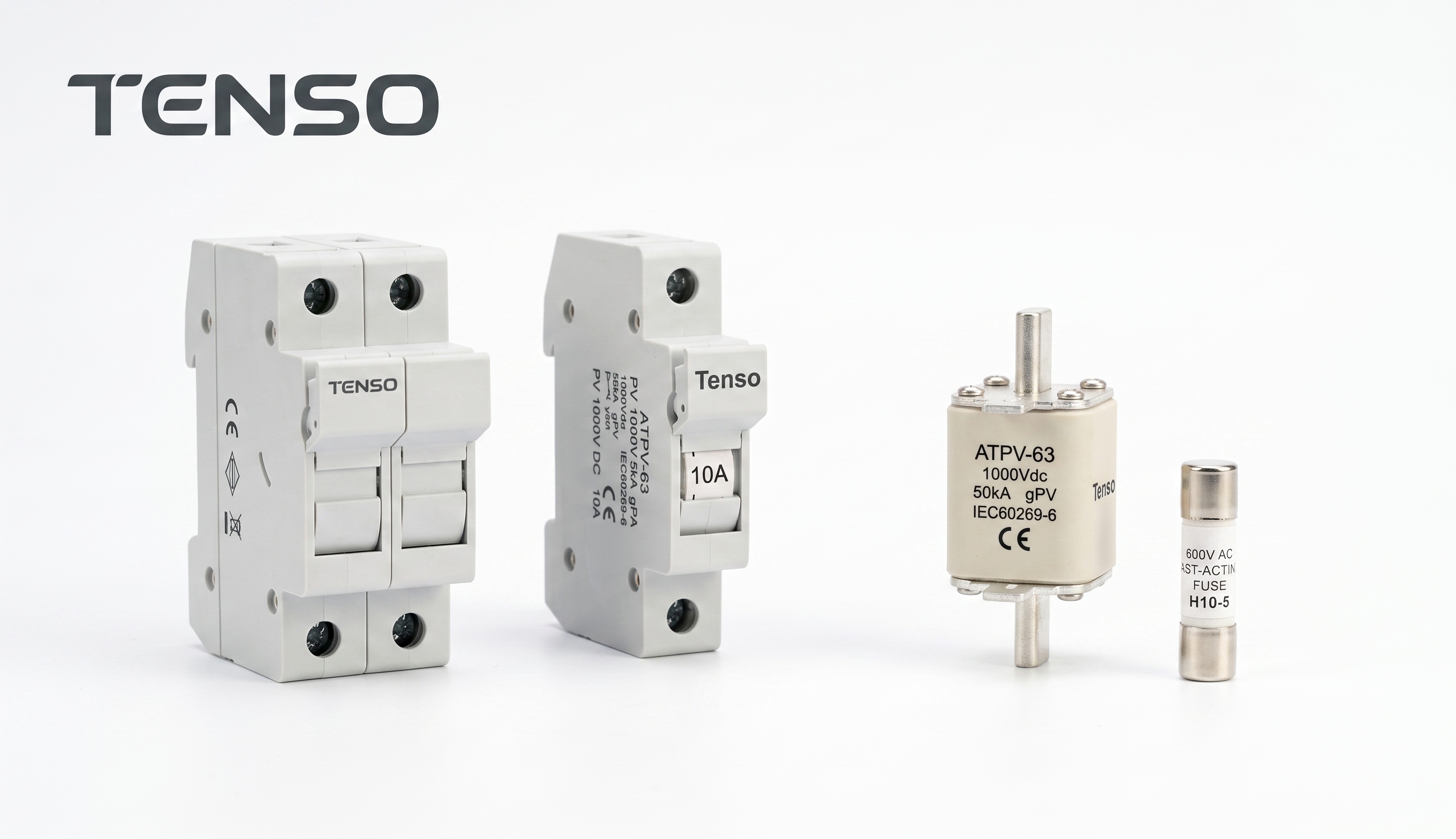
Choose gPV fuse-links and PV holders. gPV fuse-links come as cylindrical cartridges — common sizes are 10×38mm (up to ~30A), 14×51mm, and 10×85mm / 14×85mm for higher currents and 1500V — mounted in DIN-rail PV fuse holders inside the combiner box. Confirm the fuse and holder are rated to your voltage class.
Run the full checklist — not just the amps.
- Voltage class ≥ Voc,cold (600V / 1000V / 1500V), with margin.
- Current ≥ 1.56 × Isc (NEC), rounded up.
- ≤ the module’s maximum series fuse rating.
- ≤ the conductor ampacity.
- Temperature derating for the combiner environment.
- gPV certification (IEC 60269-6 / UL 2579) and adequate DC interrupting rating for the prospective fault current (the combined Isc of the other strings).
Add a DC disconnect for servicing. Pair the fuses with a DC load-break or fused disconnect rated for the array voltage so strings can be isolated safely; rooftop combiners require load-break-rated disconnects. Our fuse vs circuit breaker and isolator vs fuse switch disconnector guides help weigh the options.
Get the surrounding choices right. Confirm the AC-vs-DC question with the AC vs DC fuses guide, the general amp-sizing logic with the fuse sizing guide, and where gPV sits among other families with the complete guide to fuse types. For the industrial/inverter side, the HRC vs semiconductor comparison covers device protection.
This is technical education, not code advice — always follow the current NEC Article 690 (or IEC 62548), your AHJ’s interpretations, and the module and fuse manufacturers’ datasheets.
Key Takeaways
- Use gPV fuses only (IEC 60269-6 / UL 2579) — standard DC or automotive fuses can’t clear PV faults and may explode; non-gPV violates NEC 690.9.
- Match the voltage class to the maximum, cold-corrected voltage (Voc,cold per NEC 690.7), not the nominal — a 1000V fuse must never go on a 1500V array.
- 1500V systems enable longer strings and lower balance-of-system cost, which is why utility-scale has moved to them.
- Size at 1.56 × Isc (NEC; two 125% factors) and round up — or 1.5–2.4 × Isc under IEC.
- Respect two ceilings: the fuse must be ≤ the module’s maximum series fuse rating and ≤ the wire’s ampacity.
- String fuses are generally required at three or more parallel strings, protecting a faulted string against reverse backfeed; one or two strings often need none.
- Derate for heat (combiner boxes hit 65–75°C vs a 40°C rating) and mount fuses vertically.
- Fuse both poles in ungrounded systems, and provide an accessible DC disconnect for safe servicing, since modules stay live in daylight.
This guide is for general educational purposes, not code or design advice. Solar PV protection must be designed and installed by a qualified professional in accordance with the current NEC Article 690 (or IEC 62548), local codes and AHJ requirements, and the module and fuse manufacturers’ datasheets.
Frequently asked questions
What's the difference between a 1000V and a 1500V PV fuse?
Their maximum DC voltage rating. A 1000V fuse suits commercial arrays whose cold-corrected voltage stays below 1000V; a 1500V fuse is for utility-scale arrays up to ~1500V. The fuse's rating must meet or exceed the array's maximum open-circuit voltage at the coldest temperature — a 1000V fuse must never be used on a 1500V system.
How do I size a solar string fuse?
In North America, multiply the module's short-circuit current (Isc) by 1.56 and round up to the next standard size. Then confirm the result is both at or below the module's maximum series fuse rating and at or below the wire's ampacity. Under IEC, the range is 1.5–2.4 × Isc.
Why 1.56 × Isc?
It's two 125% factors combined: 125% for maximum current (PV can exceed rated Isc in cold, high-irradiance, cloud-edge conditions) and 125% for continuous duty (a PV array runs 3+ hours). 1.25 × 1.25 ≈ 1.56.
Do I always need string fuses?
No. With only one or two strings in parallel, fuses generally aren't required, because reverse current is limited. Once three or more strings are combined — or if the backfeed could exceed the module's maximum series fuse rating — string fuses are required. Many installers fit them anyway for isolation and future expansion.
Can I use a regular DC or automotive fuse for solar?
No. Standard fuses aren't tested to interrupt PV reverse currents and can fail catastrophically — even explode — during a fault, and using them violates NEC 690.9. Use only gPV fuses certified to IEC 60269-6 or UL 2579.
Why do PV systems need special (gPV) fuses at all?
Because a PV module is a current-limited source (fault current barely exceeds normal current), the fault is DC (no zero-crossing to quench the arc), and paralleled strings create reverse currents. gPV fuses are built and tested for exactly these conditions.
What voltage rating do I actually calculate to?
The array's maximum open-circuit voltage corrected for the coldest expected temperature (Voc,cold per NEC 690.7), not the nominal voltage — Voc rises as temperature drops. Choose a fuse class above that, with roughly 20–25% margin.
Where do the fuses go, and how should they be mounted?
In the combiner box, one per string (both poles in ungrounded systems), ideally mounted vertically for cooling and drainage, with a readily accessible DC disconnect so they can be serviced without working on live conductors.
Request a quote
Know the circuit but not the part?
Tell us the voltage, current and what you're protecting — our applications team will spec it and quote within one business day.